#
#
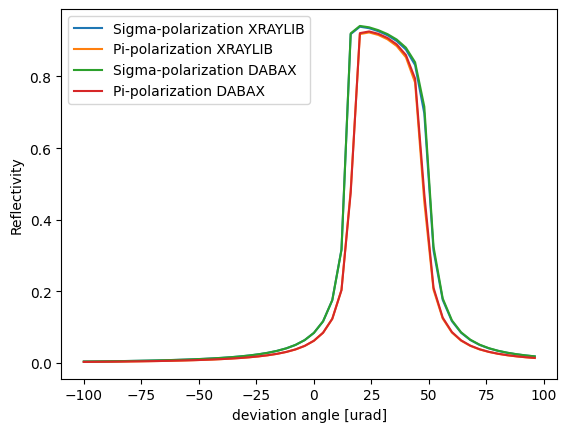
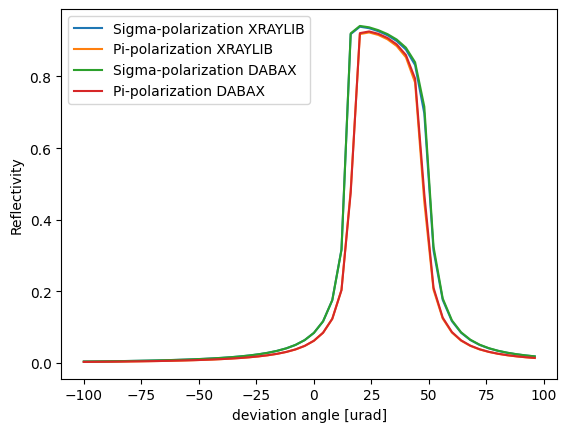
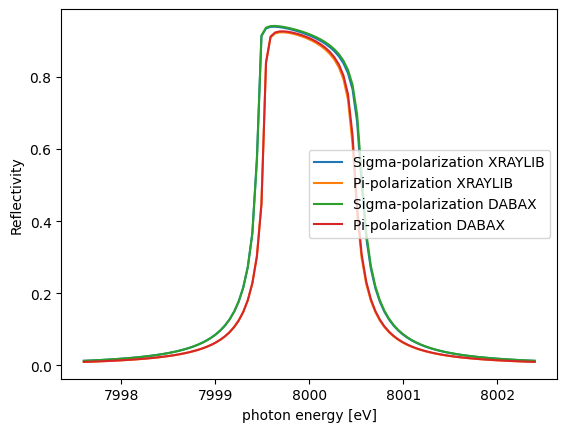
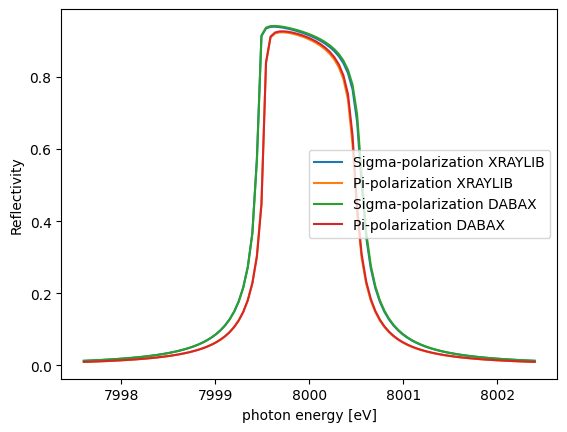
# This example shows the diffraction by a Si 111 crystal calculated in its simplest implementation
# and compares the results using xrayly and dabax.
# It also compares the calculation time.
# Note the differences in computing time using dabax:
# it is very slow if using it in an iterative way
# it is much faster when using the vector capabilities (accelerated).
#
# Xraylib is always faster than dabax.
#
import numpy
from crystalpy.diffraction.GeometryType import BraggDiffraction
from crystalpy.diffraction.DiffractionSetupXraylib import DiffractionSetupXraylib
from crystalpy.diffraction.DiffractionSetupDabax import DiffractionSetupDabax
from crystalpy.diffraction.Diffraction import Diffraction
from crystalpy.util.Vector import Vector
from crystalpy.util.Photon import Photon
from crystalpy.diffraction.PerfectCrystalDiffraction import PerfectCrystalDiffraction
from dabax.dabax_xraylib import DabaxXraylib
import time
#
def calculate_simple_diffraction_angular_scan(calculation_method=0, calculation_strategy_flag=0):
# Create a diffraction setup.
print("\nCreating a diffraction setup...")
diffraction_setup = DiffractionSetupXraylib(geometry_type = BraggDiffraction(), # GeometryType object
crystal_name = "Si", # string
thickness = 1e-2, # meters
miller_h = 1, # int
miller_k = 1, # int
miller_l = 1, # int
asymmetry_angle = 0,#10.0*numpy.pi/180., # radians
azimuthal_angle = 0.0) # radians # int
diffraction_setup_dabax = DiffractionSetupDabax(geometry_type = BraggDiffraction(), # GeometryType object
crystal_name = "Si", # string
thickness = 1e-2, # meters
miller_h = 1, # int
miller_k = 1, # int
miller_l = 1, # int
asymmetry_angle = 0,#10.0*numpy.pi/180., # radians
azimuthal_angle = 0.0,
dabax=DabaxXraylib()) # radians
energy = 8000.0 # eV
angle_deviation_min = -100e-6 # radians
angle_deviation_max = 100e-6 # radians
angle_deviation_points = 50
angle_step = (angle_deviation_max-angle_deviation_min)/angle_deviation_points
#
# gets Bragg angle needed to create deviation's scan
#
bragg_angle = diffraction_setup.angleBragg(energy)
print("Bragg angle for E=%f eV is %f deg"%(energy,bragg_angle*180.0/numpy.pi))
# initialize arrays for storing outputs
deviations = numpy.zeros(angle_deviation_points)
intensityS = numpy.zeros(angle_deviation_points)
intensityP = numpy.zeros(angle_deviation_points)
intensityS_dabax = numpy.zeros(angle_deviation_points)
intensityP_dabax = numpy.zeros(angle_deviation_points)
t0 = time.time()
for ia in range(angle_deviation_points):
deviation = angle_deviation_min + ia * angle_step
angle = deviation + bragg_angle
# calculate the components of the unitary vector of the incident photon scan
# Note that diffraction plane is YZ
yy = numpy.cos(angle)
zz = - numpy.abs(numpy.sin(angle))
photon = Photon(energy_in_ev=energy,direction_vector=Vector(0.0,yy,zz))
# perform the calculation
coeffs = Diffraction.calculateDiffractedComplexAmplitudes(diffraction_setup, photon,
calculation_method=calculation_method,
calculation_strategy_flag=calculation_strategy_flag)
# store results
deviations[ia] = deviation
intensityS[ia] = numpy.abs(coeffs['S'])**2 # coeffs['S'].intensity()
intensityP[ia] = numpy.abs(coeffs['P'])**2 # coeffs['P'].intensity()
t1 = time.time()
for ia in range(angle_deviation_points):
deviation = angle_deviation_min + ia * angle_step
angle = deviation + bragg_angle
# calculate the components of the unitary vector of the incident photon scan
# Note that diffraction plane is YZ
yy = numpy.cos(angle)
zz = - numpy.abs(numpy.sin(angle))
photon = Photon(energy_in_ev=energy,direction_vector=Vector(0.0,yy,zz))
# perform the calculation
coeffs_dabax = Diffraction.calculateDiffractedComplexAmplitudes(diffraction_setup_dabax, photon,
calculation_method=calculation_method,
calculation_strategy_flag=calculation_strategy_flag)
# store results
deviations[ia] = deviation
intensityS_dabax[ia] = numpy.abs(coeffs_dabax['S'])**2
intensityP_dabax[ia] = numpy.abs(coeffs_dabax['P'])**2
t2 = time.time()
# plot results
import matplotlib.pylab as plt
plt.plot(1e6*deviations,intensityS)
plt.plot(1e6*deviations,intensityP)
plt.plot(1e6*deviations,intensityS_dabax)
plt.plot(1e6*deviations,intensityP_dabax)
plt.xlabel("deviation angle [urad]")
plt.ylabel("Reflectivity")
plt.legend(["Sigma-polarization XRAYLIB","Pi-polarization XRAYLIB","Sigma-polarization DABAX","Pi-polarization DABAX"])
plt.show()
print("Total time, Time per point XRAYLIB: ", t1-t0, (t1-t0) / angle_deviation_points)
print("Total time, Time per point DABAX: ", t2-t1, (t2-t1) / angle_deviation_points)
def calculate_simple_diffraction_angular_scan_accelerated(calculation_method=0, calculation_strategy_flag=0, diffraction_dabax=0):
# Create a diffraction setup.
print("\nCreating a diffraction setup...")
diffraction_setup = DiffractionSetupXraylib(geometry_type = BraggDiffraction(), # GeometryType object
crystal_name = "Si", # string
thickness = 1e-2, # meters
miller_h = 1, # int
miller_k = 1, # int
miller_l = 1, # int
asymmetry_angle = 0,#10.0*numpy.pi/180., # radians
azimuthal_angle = 0.0) # radians # int
diffraction_setup_dabax = DiffractionSetupDabax(geometry_type = BraggDiffraction(), # GeometryType object
crystal_name = "Si", # string
thickness = 1e-2, # meters
miller_h = 1, # int
miller_k = 1, # int
miller_l = 1, # int
asymmetry_angle = 0,#10.0*numpy.pi/180., # radians
azimuthal_angle = 0.0,
dabax=DabaxXraylib()) # radians
energy = 8000.0 # eV
angle_deviation_min = -100e-6 # radians
angle_deviation_max = 100e-6 # radians
angle_deviation_points = 50
angle_step = (angle_deviation_max-angle_deviation_min)/angle_deviation_points
#
# gets Bragg angle needed to create deviation's scan
#
bragg_angle = diffraction_setup.angleBragg(energy)
print("Bragg angle for E=%f eV is %f deg"%(energy,bragg_angle*180.0/numpy.pi))
# initialize arrays for storing outputs
deviations = numpy.zeros(angle_deviation_points)
intensityS = numpy.zeros(angle_deviation_points)
intensityP = numpy.zeros(angle_deviation_points)
intensityS_dabax = numpy.zeros(angle_deviation_points)
intensityP_dabax = numpy.zeros(angle_deviation_points)
t0 = time.time()
for ia in range(angle_deviation_points):
deviation = angle_deviation_min + ia * angle_step
angle = deviation + bragg_angle
# calculate the components of the unitary vector of the incident photon scan
# Note that diffraction plane is YZ
yy = numpy.cos(angle)
zz = - numpy.abs(numpy.sin(angle))
photon = Photon(energy_in_ev=energy,direction_vector=Vector(0.0,yy,zz))
# perform the calculation
coeffs = Diffraction.calculateDiffractedComplexAmplitudes(diffraction_setup, photon,
calculation_method=calculation_method,
calculation_strategy_flag=calculation_strategy_flag)
# store results
deviations[ia] = deviation
intensityS[ia] = numpy.abs(coeffs['S']) ** 2
intensityP[ia] = numpy.abs(coeffs['P']) ** 2
psi_0, psi_H, psi_H_bar = diffraction_setup_dabax.psiAll(energy)
t1 = time.time()
for ia in range(angle_deviation_points):
deviation = angle_deviation_min + ia * angle_step
angle = deviation + bragg_angle
# calculate the components of the unitary vector of the incident photon scan
# Note that diffraction plane is YZ
yy = numpy.cos(angle)
zz = - numpy.abs(numpy.sin(angle))
photon = Photon(energy_in_ev=energy,direction_vector=Vector(0.0,yy,zz))
# Create PerfectCrystalDiffraction instance.
perfect_crystal = PerfectCrystalDiffraction(geometry_type=diffraction_setup_dabax.geometryType(),
bragg_normal=diffraction_setup_dabax.vectorH(),
surface_normal=diffraction_setup_dabax.vectorNormalSurface(),
bragg_angle=diffraction_setup_dabax.angleBragg(energy),
psi_0=psi_0,
psi_H=psi_H,
psi_H_bar=psi_H_bar,
thickness=diffraction_setup_dabax.thickness(),
d_spacing=diffraction_setup_dabax.dSpacing() * 1e-10,
calculation_strategy_flag=calculation_strategy_flag)
complex_amplitudes = perfect_crystal.calculateDiffraction(photon, calculation_method=calculation_method)
deviations[ia] = deviation
intensityS_dabax[ia] = numpy.abs(complex_amplitudes['S']) ** 2
intensityP_dabax[ia] = numpy.abs(complex_amplitudes['P']) ** 2
t2 = time.time()
# plot results
import matplotlib.pylab as plt
plt.plot(1e6*deviations,intensityS)
plt.plot(1e6*deviations,intensityP)
plt.plot(1e6*deviations,intensityS_dabax)
plt.plot(1e6*deviations,intensityP_dabax)
plt.xlabel("deviation angle [urad]")
plt.ylabel("Reflectivity")
plt.legend(["Sigma-polarization XRAYLIB","Pi-polarization XRAYLIB","Sigma-polarization DABAX","Pi-polarization DABAX"])
plt.show()
print("Total time, Time per point XRAYLIB: ", t1-t0, (t1-t0) / angle_deviation_points)
print("Total time, Time per point DABAX: ", t2-t1, (t2-t1) / angle_deviation_points)
def calculate_simple_diffraction_energy_scan(calculation_method=0, diffraction_dabax=0, calculation_strategy_flag=0):
# Create a diffraction setup.
print("\nCreating a diffraction setup...")
diffraction_setup = DiffractionSetupXraylib(geometry_type = BraggDiffraction(), # GeometryType object
crystal_name = "Si", # string
thickness = 1e-2, # meters
miller_h = 1, # int
miller_k = 1, # int
miller_l = 1, # int
asymmetry_angle = 0,#10.0*numpy.pi/180., # radians
azimuthal_angle = 0.0) # radians # int
diffraction_setup_dabax = DiffractionSetupDabax(geometry_type = BraggDiffraction(), # GeometryType object
crystal_name = "Si", # string
thickness = 1e-2, # meters
miller_h = 1, # int
miller_k = 1, # int
miller_l = 1, # int
asymmetry_angle = 0,#10.0*numpy.pi/180., # radians
azimuthal_angle = 0.0,
dabax=DabaxXraylib()) # radians
energy = 8000.0 # eV
angle_deviation_min = -100e-6 # radians
angle_deviation_max = 100e-6 # radians
angle_deviation_points = 50
angle_step = (angle_deviation_max-angle_deviation_min)/angle_deviation_points
#
# gets Bragg angle needed to create deviation's scan
#
bragg_angle_corrected = diffraction_setup.angleBraggCorrected(energy)
print("Bragg angle corrected for E=%f eV is %f deg"%(energy,bragg_angle_corrected*180.0/numpy.pi))
DeltaE = energy * 1e-4
npoints = 100
energies = numpy.linspace(energy-3*DeltaE, energy+3*DeltaE, npoints)
# initialize arrays for storing outputs
intensityS = numpy.zeros(npoints)
intensityP = numpy.zeros(npoints)
intensityS_dabax = numpy.zeros(npoints)
intensityP_dabax = numpy.zeros(npoints)
t0 = time.time()
for ia in range(npoints):
# calculate the components of the unitary vector of the incident photon scan
# Note that diffraction plane is YZ
yy = numpy.cos(bragg_angle_corrected)
zz = - numpy.abs(numpy.sin(bragg_angle_corrected))
photon = Photon(energy_in_ev=energies[ia],direction_vector=Vector(0.0,yy,zz))
# perform the calculation
coeffs = Diffraction.calculateDiffractedComplexAmplitudes(diffraction_setup, photon,
calculation_method=calculation_method,
calculation_strategy_flag=calculation_strategy_flag)
# store results
intensityS[ia] = numpy.abs(coeffs['S'])**2 # coeffs['S'].intensity()
intensityP[ia] = numpy.abs(coeffs['P'])**2 # coeffs['P'].intensity()
t1 = time.time()
for ia in range(npoints):
# calculate the components of the unitary vector of the incident photon scan
# Note that diffraction plane is YZ
yy = numpy.cos(bragg_angle_corrected)
zz = - numpy.abs(numpy.sin(bragg_angle_corrected))
photon = Photon(energy_in_ev=energies[ia],direction_vector=Vector(0.0,yy,zz))
# perform the calculation
coeffs_dabax = Diffraction.calculateDiffractedComplexAmplitudes(diffraction_setup_dabax, photon,
calculation_method=calculation_method,
calculation_strategy_flag=calculation_strategy_flag)
# store results
intensityS_dabax[ia] = numpy.abs(coeffs_dabax['S'])**2
intensityP_dabax[ia] = numpy.abs(coeffs_dabax['P'])**2
t2 = time.time()
# plot results
import matplotlib.pylab as plt
plt.plot(energies,intensityS)
plt.plot(energies,intensityP)
plt.plot(energies,intensityS_dabax)
plt.plot(energies,intensityP_dabax)
plt.xlabel("photon energy [eV]")
plt.ylabel("Reflectivity")
plt.legend(["Sigma-polarization XRAYLIB","Pi-polarization XRAYLIB","Sigma-polarization DABAX","Pi-polarization DABAX"])
plt.show()
print("Total time, Time per point XRAYLIB: ", t1-t0, (t1-t0) / npoints)
print("Total time, Time per point DABAX: ", t2-t1, (t2-t1) / npoints)
def calculate_simple_diffraction_energy_scan_accelerated(calculation_method=0, calculation_strategy_flag=0):
# Create a diffraction setup.
print("\nCreating a diffraction setup...")
diffraction_setup = DiffractionSetupXraylib(geometry_type = BraggDiffraction(), # GeometryType object
crystal_name = "Si", # string
thickness = 1e-2, # meters
miller_h = 1, # int
miller_k = 1, # int
miller_l = 1, # int
asymmetry_angle = 0,#10.0*numpy.pi/180., # radians
azimuthal_angle = 0.0) # radians # int
diffraction_setup_dabax = DiffractionSetupDabax(geometry_type = BraggDiffraction(), # GeometryType object
crystal_name = "Si", # string
thickness = 1e-2, # meters
miller_h = 1, # int
miller_k = 1, # int
miller_l = 1, # int
asymmetry_angle = 0,#10.0*numpy.pi/180., # radians
azimuthal_angle = 0.0,
dabax=DabaxXraylib()) # radians
energy = 8000.0 # eV
angle_deviation_min = -100e-6 # radians
angle_deviation_max = 100e-6 # radians
angle_deviation_points = 50
angle_step = (angle_deviation_max-angle_deviation_min)/angle_deviation_points
#
# gets Bragg angle needed to create deviation's scan
#
bragg_angle_corrected = diffraction_setup.angleBraggCorrected(energy)
print("Bragg angle corrected for E=%f eV is %f deg"%(energy,bragg_angle_corrected*180.0/numpy.pi))
DeltaE = energy * 1e-4
npoints = 100
energies = numpy.linspace(energy-3*DeltaE, energy+3*DeltaE, npoints)
# initialize arrays for storing outputs
intensityS = numpy.zeros(npoints)
intensityP = numpy.zeros(npoints)
intensityS_dabax = numpy.zeros(npoints)
intensityP_dabax = numpy.zeros(npoints)
t0 = time.time()
for ia in range(npoints):
# calculate the components of the unitary vector of the incident photon scan
# Note that diffraction plane is YZ
yy = numpy.cos(bragg_angle_corrected)
zz = - numpy.abs(numpy.sin(bragg_angle_corrected))
photon = Photon(energy_in_ev=energies[ia],direction_vector=Vector(0.0,yy,zz))
# perform the calculation
coeffs = Diffraction.calculateDiffractedComplexAmplitudes(diffraction_setup, photon,
calculation_method=calculation_method,
calculation_strategy_flag=calculation_strategy_flag)
# store results
intensityS[ia] = numpy.abs(coeffs['S']) ** 2
intensityP[ia] = numpy.abs(coeffs['P']) ** 2
COOR = []
ENER = []
for ia in range(npoints):
# calculate the components of the unitary vector of the incident photon scan
# Note that diffraction plane is YZ
yy = numpy.cos(bragg_angle_corrected)
zz = - numpy.abs(numpy.sin(bragg_angle_corrected))
COOR.append([0.0,yy,zz])
ENER.append(energies[ia])
t1 = time.time()
Psi_0, Psi_H, Psi_H_bar = diffraction_setup_dabax.psiAll(ENER)
for ia in range(npoints):
# perform the calculation
incoming_photon = Photon(energy_in_ev=ENER[ia],direction_vector=Vector(COOR[ia][0],COOR[ia][1],COOR[ia][2]))
energy = ENER[ia]
# psi_0, psi_H, psi_H_bar = diffraction_setup_dabax.psiAll(energy)
psi_0, psi_H, psi_H_bar = Psi_0[ia], Psi_H[ia], Psi_H_bar[ia]
# Create PerfectCrystalDiffraction instance.
perfect_crystal = PerfectCrystalDiffraction(geometry_type=diffraction_setup_dabax.geometryType(),
bragg_normal=diffraction_setup_dabax.vectorH(),
surface_normal=diffraction_setup_dabax.vectorNormalSurface(),
bragg_angle=diffraction_setup_dabax.angleBragg(energy),
psi_0=psi_0,
psi_H=psi_H,
psi_H_bar=psi_H_bar,
thickness=diffraction_setup_dabax.thickness(),
d_spacing=diffraction_setup_dabax.dSpacing() * 1e-10,
calculation_strategy_flag=calculation_strategy_flag)
complex_amplitudes = perfect_crystal.calculateDiffraction(incoming_photon, calculation_method=calculation_method)
intensityS_dabax[ia] = numpy.abs(complex_amplitudes['S']) ** 2 # 0.0 # coeffs_dabax['S'].intensity()
intensityP_dabax[ia] = numpy.abs(complex_amplitudes['P']) ** 2 # 0.0 # coeffs_dabax['P'].intensity()
t2 = time.time()
# plot results
import matplotlib.pylab as plt
plt.plot(energies,intensityS)
plt.plot(energies,intensityP)
plt.plot(energies,intensityS_dabax)
plt.plot(energies,intensityP_dabax)
plt.xlabel("photon energy [eV]")
plt.ylabel("Reflectivity")
plt.legend(["Sigma-polarization XRAYLIB","Pi-polarization XRAYLIB","Sigma-polarization DABAX","Pi-polarization DABAX"])
plt.show()
print("Total time, Time per point XRAYLIB: ", t1-t0, (t1-t0) / npoints)
print("Total time, Time per point DABAX: ", t2-t1, (t2-t1) / npoints)
#
# main
#
if __name__ == "__main__":
calculation_method = 0 # 0=Zachariasen, 1=Guigay
calculation_strategy_flag = 2 # 0=mpmath 1=numpy 2=numpy-truncated
calculate_simple_diffraction_angular_scan( calculation_method=calculation_method, calculation_strategy_flag=calculation_strategy_flag)
calculate_simple_diffraction_angular_scan_accelerated(calculation_method=calculation_method, calculation_strategy_flag=calculation_strategy_flag)
calculate_simple_diffraction_energy_scan( calculation_method=calculation_method, calculation_strategy_flag=calculation_strategy_flag)
calculate_simple_diffraction_energy_scan_accelerated(calculation_method=calculation_method, calculation_strategy_flag=calculation_strategy_flag)